Together, Columbus can become a community that connects everyone with a communication disorder to treatment. Communication is vital. Communication is key to meaningful relationships, mental health, physical wellbeing, academic success and financial stability.
For more than 100 years, Columbus Speech & Hearing has been a leader in audiology care for people experiencing hearing challenges. Right now, our funding limits who can access us.
If you would like to make a gift, please email resourcedev@columbusspeech.org or click the button below.
About Columbus Speech & Hearing
Our mission is to unlock potential for individuals with communication challenges through all stages of life. From birth to seniors, Columbus Speech and Hearing personalizes programs and services to meet the needs of clients. Everyone deserves the ability to hear and to be heard. Each year more than 8,000 people are impacted by our outstanding programs.
It is because of our highly talented and caring staff that we can help so many people to overcome communication challenges. We currently have 30 compassionate audiologists who work tirelessly to ensure that every person understands and can be understood.
Located Across Central Ohio
We have three locations in Clintonville, Dublin and Westerville. Thanks to grant funds from United Way and Franklin County Office on Aging, our team goes beyond our walls to find the children and seniors who need us in our most vulnerable neighborhoods. And in partnership with the state of Ohio, DeafBlind individuals in Columbus, Cincinnati, and Cleveland can access one-on-one support service providers (SSPs) and overcome the isolation of their disability. Columbus Speech & Hearing continues to seek those who are in need of our programs and services.
What is the “Say it Loud” Initiative?
After careful conversations with clients and the community, the Board of Trustees will launch a fundraising initiative to raise an additional $1.25 million by December 2026 for the following:
- Lifelong connections (Hearing)
- Community Access & Locations
- Clinical Technology and Innovation
Lifelong Connections (Hearing)
Hearing loss can be life and death when untreated, and Columbus Speech & Hearing is the local expert at treating hearing loss.
For seniors, hearing loss is the third most common chronic health issue — more common than diabetes or cancer — and is often undiagnosed and untreated.
On average, individuals with hearing loss experience lower incomes [2, 3], worse physical and mental health [4 – 6], and a greater risk of hospitalization [7, 8] than their hearing counterparts. The good news is that the regular use of hearing aids can significantly reduce negative effects of hearing loss and improve overall quality of life.
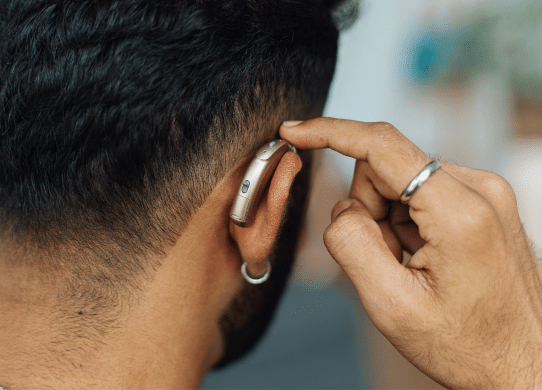
Research shows that wearing hearing aids can mitigate the risk of income loss by 90-100% in individuals with mild hearing loss and 65-77% in those with moderate to severe hearing loss [9]. Additionally, regular hearing aid use can extend an individual’s life expectancy by 24% [10] and slow the rate of cognitive decline and dementia onset by 19% [11].
Columbus Speech & Hearing believes that cost should never be a reason that our senior patients don’t have the hearing devices that they need. Private health insurance coverage does not consistently cover hearing aids. Traditional Medicare does not cover the cost of hearing aids. Columbus Speech & Hearing has developed programs to offer free screenings for hearing, free hearing aids at no cost or very low cost, and free hearing aid repair services.
In partnership with the Franklin County Office on Aging “Senior Options” grant program, Columbus Speech and Hearing has provided 6,000 hearing evaluations over the past 30 years to low-income seniors. However, there is currently a funding gap of $75,000 to $100,000 to reach all of the low-income seniors known to need hearing services. Because our grant support from the Office on Aging is capped, Columbus Speech & Hearing is seeking additional funding for this fast-growing area of need related to our mission.
Community Access & Locations
Transportation can be a barrier for any lower-income neighbor seeking healthcare services, so Columbus Speech & Hearing has let client data drive which neighborhoods we expand further into. Today, Columbus Speech & Hearing has three locations serving the central Ohio area, with our Westerville location being the newest in 2022.
In 2023, our impact was the greatest in our 100-year history. CSH provided 16,373 treatment sessions, conducted 3,790 screenings for communication disorders, and visited more than 40 locations to meet our clients where they are.
As we plan ways to reach more people facing a communication disorder, we know it’s time to expand into new communities. For our low-income clients, multiple offices give clients options to save travel time and gas money by selecting their closest to home location. Grove City is our next target location. But looking further into the future, we expect to outgrow our headquarters. Funding and philanthropy will shape our expansion plans.
Clinical Technology & Innovation
New technology can be life-changing for individuals with hearing loss, and Columbus Speech & Hearing is at the forefront of adopting the best tools. Columbus Speech & Hearing is committed to innovating therapies and being an early adopter of new technology. Technology can offer connection, confidence, and quality of life for those living with a communication disorder.
For individuals with hearing loss, Artificial Intelligence has created an evolution of hearing aid devices that can automatically adjust and adapt in different sound environments. And our clinics are a lifeline for people with new cochlear implants, as we partner with surgical experts to activate implanted devices, and to partner with clients for their years of ongoing clinical care.
Columbus Speech & Hearing is invested in continuing education for our clinicians to embrace the latest technology, sample devices for our clients to trial, and collaboration across teams to innovate which therapies best fit a client’s unique needs. Funds are needed for our organization to make an impact with technology and innovation.
- Hollo A, Wehby JH, Oliver RM. Unidentified Language Deficits in Children with Emotional and Behavioral Disorders: A Meta-Analysis. Exceptional Children. 2014;80(2):169-186. doi:https://doi.org/10.1177/001440291408000203
- Agrawal Y, Platz EA, Niparko JK. Prevalence of hearing loss and differences by demographic characteristics among US adults: data from the National Health and Nutrition Examination Survey, 1999-2004. Arch Intern Med. 2008;168(14):1522-1530. doi:10.1001/archinte.168.14.1522
- Blanchfield BB, Feldman JJ, Dunbar JL, Gardner EN. The severely to profoundly hearing-impaired population in the United States: prevalence estimates and demographics. J Am Acad Audiol. 2001;12(4):183-189.https://pubmed.ncbi.nlm.nih.gov/11332518/
- McKee MM, Stransky ML, Reichard A. Hearing loss and associated medical conditions among individuals 65 years and older. Disabil Health J. 2018;11(1):122-125. doi:10.1016/j.dhjo.2017.05.007
- Solheim J, Kværner KJ, Falkenberg ES. Daily life consequences of hearing loss in the elderly. Disabil Rehabil. 2011;33(23-24):2179-2185. doi:10.3109/09638288.2011.563815
- Chen DS, Betz J, Yaffe K, et al. Association of hearing impairment with declines in physical functioning and the risk of disability in older adults. J Gerontol A Biol Sci Med Sci. 2015;70(5):654-661. doi:10.1093/gerona/glu207
- Genther DJ, Betz J, Pratt S, et al. Association Between Hearing Impairment and Risk of Hospitalization in Older Adults. J Am Geriatr Soc. 2015;63(6):1146-1152. doi:10.1111/jgs.13456
- Hsu AK, McKee M, Williams S, et al. Associations among hearing loss, hospitalization, readmission and mortality in older adults: A systematic review. Geriatr Nurs. 2019;40(4):367-379. doi:10.1016/j.gerinurse.2018.12.013
- Kochkin S. MarkeTrak VIII: The efficacy of hearing aids in achieving compensation equity in the workplace. The Hearing Journal. 2010;63(10):19-24. doi:https://doi.org/10.1097/01.hj.0000389923.80044.e6
- Choi JS, Adams ME, Crimmins EM, Lin FR, Ailshire JA. Association between hearing aid use and mortality in adults with hearing loss in the USA: a mortality follow-up study of a cross-sectional cohort. Lancet Healthy Longev. 2024;5(1):e66-e75. doi:10.1016/S2666-7568(23)00232-5
- Yeo BSY, Song HJJMD, Toh EMS, et al. Association of Hearing Aids and Cochlear Implants With Cognitive Decline and Dementia: A Systematic Review and Meta-analysis. JAMA Neurol. 2023;80(2):134-141. doi:10.1001/jamaneurol.2022.4427
Learn More About Our Fundraising Efforts
As a nonprofit organization, the revenue that Columbus Speech & Hearing generates goes directly towards the advancement of our mission: to help people improve communication for life. Your gift is a crucial step in our plan to expand our audiology services, increase community access, and offer the latest technology to clients.
Our development team is here to answer any questions you may have about the "Say it Loud" initiative and explain how your gift — no matter the amount — will make a difference in our community.
Please reach out to our Development team at resourcedev@columbusspeech.org if you are interested in making a tax-deductible donation. Thank you for your support.